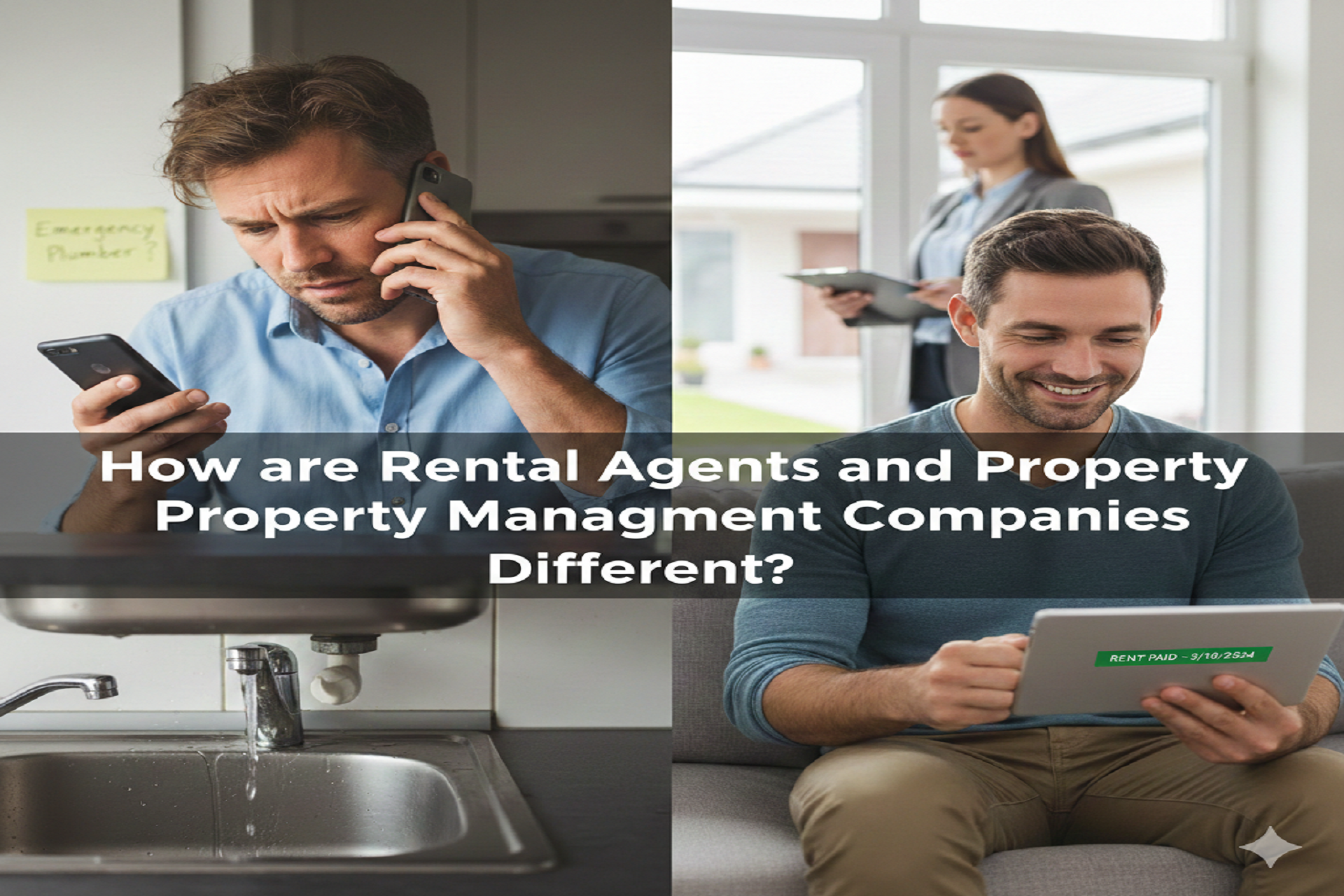
How are Rental Agents and Property Management Companies Different?

Al Spadine • December 30, 2025

This is a subtitle for your new post

TL;DR

  • Rental agents and property managers differ in their roles, responsibilities, levels of involvement, costs, etc. Understanding the same can help you make a choice that aligns with your specific needs and objectives. 
  • Rental agents primarily market and list properties, schedule showings, screen renters, and assist with lease signing. 
  • Property managers handle everything from property marketing and rent collection to maintenance, accounting, and legal compliance. 
  • Compared to rental agents, property managers allow you to enjoy hands-off investment and peace of mind. 
  • Property managers score higher than rental agents on value-for-money service, risk management, property care, and communication with tenants. 
  • If you care about upfront costs and can confidently manage your rental units without expert help, consider hiring rental agents.
  • If you lack time and expertise, have multiple units, live far away, or don’t want day-to-day involvement, hire a property manager. 


Rental Agents vs Property Management Companies: Understand the Difference 

Managing a rental business on your own isn’t a cakewalk, especially if you are new to the landscape. Most property owners need expert help. 

Hence, comparing rental agents vs property management companies is necessary to ensure smooth operations and achieve desired profitability. After all, they play different roles and their levels of involvement aren’t the same. 

Let’s explore how rental agents and property managers differ in their service scope, costs, and responsibilities across multiple aspects of property management. It can help you pick a professional who is better aligned with your goals and needs. 

What are Rental Agents?


Also known as leasing agents, these professionals help you find tenants and lease out your rental units. They play a mostly transaction-based and short-term role. 

Rental agency services usually include

  • Property marketing
  • Property listing on different rental platforms
  • Scheduling property showings and conducting them as well
  • Screening potential renters
  • Helping with signing the lease

What are Property Management Companies?

A property management company, unlike rental agents, acts as an owner’s representative and offers end-to-end services continuously and throughout a lease’s lifetime. Such companies essentially manage your rental business in every way, so you can earn hands-off. 

Here’s what they typically do:

  • Price and market the property strategically 
  • Screen and place tenants 
  • Prepare, explain, and enforce leases
  • Collect rent on time, track expenses and income, and prepare financial reports
  • Handle maintenance and repair jobs by coordinating and negotiating with vendors
  • Manage communications with tenants and resolve disputes
  • Renew leases and terminate them if necessary (in case of violations)
  • Make sure everything is done as per local, state, and federal laws as well as housings acts
  • Handle evictions and legal hassles if necessary
  • Ensure move-ins and move-outs are smooth
  • Minimize vacancy rates to maximize rental income

Rental Agents vs Property Management Companies: Chief Differences

When comparing a rental agent vs property manager, here are the key differences you cannot miss: 

Service Scope

Rental agents are only focused on leasing, and their duty ends once a lease is signed. A property management company, on the other hand, offers ongoing support that includes leasing as well as daily operations. 

Professional’s Involvement Duration  

In the case of rental agents, the involvement is short-lived and lasts till a tenant moves in. A property manager, however, stays actively involved in the long run.   

Owner’s Involvement 

As an owner, you need to manage every aspect of your rental business once a rental agent steps away after lease-signing. This means you must handle everything from rent collection and maintenance to tenant communication and lease enforcement. 

But when you partner with a property management company, you can outsource daily tasks, emergencies, and stress, while saving time and living your life.

Cost

While hiring property management companies usually costs more than rental agents, it’s worth it, and you end up with a wide array of necessary services. 

  • Rental Agents: You generally pay them a one-time leasing fee, which is a percentage of yearly rent or a month’s rent. There’s no need to pay an ongoing fee every month. 
  • Property Management Companies: Typically, you pay them 8% to 12% of the monthly rent, along with leasing or placement fees. Some companies charge maintenance or vendor coordination fee,s too. 

Legal Responsibilities

When running a rental business, you must comply with several laws and regulations so you don’t face expensive lawsuits or hefty penalties. And if you want to minimize your legal responsibilities, property management companies are a smarter choice than rental agents.   

  • Rental Agents: Though they screen tenants thoroughly, these agents don’t handle ongoing compliance, disputes, or evictions. 
  • Property Management Companies: They help you adhere to landlord-tenant laws at different levels, follow the Fair Housing Act, maintain legal documentation, and tackle evictions properly. 

Property Care


A well-maintained rental unit doesn’t just guarantee tenant satisfaction, but also preserves property value for years. However, rental agents don’t handle inspections, maintenance, or repairs as they step back right after the signing of a lease. 

Property managers do it all, though, from coordinating contractors and vendors and carrying out preventive maintenance to addressing emergency repairs. 

Tenant Communication

Rental agents interact with tenants primarily during property showings and lease signings. Their role doesn’t encompass any further communication. 

Property managers, on the other hand, handle questions around leases, maintenance requests, complaints, and renewals. They make sure to communicate with clarity, empathy, and understanding, to minimize tenant turnover. 

Should You Opt for Rental Agents or Property Management Companies? 

Now that you have a grip on the differences between a rental agent and a property manager, it’s time to make an informed decision. So, ideally, go for a:

  • Rental agent, if you want to keep costs low, need help with finding tenants only, and can manage the property and tenant issues yourself. 
  • Property management, if you live far from your rental units, own multiple properties, lack rental business experience or enough time, and prefer a hands-off approach. 

Many property owners also adopt a hybrid approach. This means they hire a rental agent for the tenant screening and leasing, and then transition to a property management company once the tenant moves in. 

Conclusion 

All in all, whether you pick a rental agent or a

property management company

 depends on your lifestyle, expertise as a property owner, goals, and budget. If you are confident of managing rental units on your own and want to minimize upfront costs, rental agents can help. 

However, if you are looking for a hands-off, stress-free investment, consider availing property management services. You can save your time, energy, and peace while a property manager handles everything from tenant screening to legal compliance to financial reporting. 

Consider Guardian Property Management for Top-Notch Professional Services 

Our experts at

Guardian Property Management

 efficiently handle different rental properties, so you can rest assured about profitability, risk management, tenant quality, and property value preservation. Our competitive fees also help you get on board easily.

Contact us

 for more details today. We are easily reached at

651-287-2011

 or via

info@guardianprop.com

FAQs

Q1. Who costs more: a rental agent or a property manager? 

Ans. Hiring property managers usually costs more. However, they offer a comprehensive range of services, so you can enjoy a hands-off investment experience and earn passively without any worries. 

Q2. Can rental agents help me handle tenant communications? 

Ans. Rental agents can deal with tenant communications only during showings and lease-signing. Their job is done after that. Hence, you need to handle further communications, disputes, complaints, and queries yourself. 

Q3. Is it enough to hire a rental agent if I live far from my properties? 

Ans. No, it’s better to hire a property management company. They can take care of everything from rent collection and maintenance to lease renewals, transitions, and accounting. Your involvement will be minimal. 

Q4. Can rental agents help if I need to evict a tenant after multiple lease violations? 

Ans. No, a rental agent’s role doesn’t extend beyond lease-signing. You will need a knowledgeable and experienced property manager to handle evictions lawfully. 

Q5. How can property managers help reduce tenant turnover? 

Ans. Property managers handle tenant queries, complaints, and disputes promptly. Plus, they address queries regarding leases as well as maintenance and repair requests efficiently. This helps boost tenant satisfaction and retention.


Share this post

short-term versus long-term rentals
By Dawn Jameson January 5, 2026
Poorly planned rental strategies can increase expenses and reduce occupancy. Explore the pros and cons of short-term versus long-term rentals.
Rental Property Management Costs
By Dawn Jameson December 15, 2025
Management fees vary based on property condition and service needs. Understand common pricing and what landlords usually pay.
December 9, 2025
TL;DR An assumable mortgage allows a homebuyer to take over the seller’s existing loan instead of applying for a new one. This can mean inheriting a lower interest rate, original loan terms, and predictable monthly payments. FHA, VA, and USDA loans are typically assumable, while most conventional loans are not. Buyers must qualify with the lender and compensate the seller for their existing home equity. In high-interest-rate markets, assumable mortgages can offer significant long-term savings. For sellers, offering an assumable loan can make a property more attractive and competitive. Why an Assumable Mortgage Is Gaining Attention in Today’s Housing Market As mortgage rates remain elevated, many buyers are searching for smarter ways to finance a home without locking into costly new loans. One increasingly attractive solution is an assumable mortgage, which allows qualified buyers to step into an existing loan rather than starting from scratch. For buyers exploring assumable mortgage listings, this strategy can unlock access to lower interest rates, reduced closing costs, and more favorable loan terms than what’s currently available. Understanding how an assumable mortgage works can help you make a more confident, cost-effective decision. What Is an Assumable Mortgage? With an assumable mortgage, homebuyers can purchase a property by assuming the seller's existing mortgage loan. This option is particularly appealing when buyers want to benefit from lower interest rates, especially if rates have increased since the seller originally obtained the loan. By taking over the seller’s mortgage, the buyer inherits the same financing terms, including the interest rate, remaining balance, and repayment schedule. This approach can reduce borrowing costs and provide a strategic alternative to traditional mortgage financing. Why Choose an Assumable Mortgage? In a market where 30-year mortgage rates hover around 7.19%, affordability has become a major challenge for many buyers. Here’s why assuming an existing loan can be a strategic advantage in this environment. By assuming a mortgage, buyers can take over mortgage payments tied to an existing loan while preserving its original interest rate and repayment terms. This can make homeownership more accessible, even when market conditions are unfavorable. Additionally, sellers benefit by offering assumable loans, as they create a compelling incentive for buyers to accept higher sale prices in exchange for better financing terms. Some Examples of Assumable Loans Not all mortgages can be assumed, so understanding which loan types qualify is critical. Below are the primary types of assumable home loans buyers may encounter. FHA Loans To assume an FHA loan, buyers must meet standard FHA eligibility requirements. This typically includes a minimum down payment of 3.5% and a credit score of at least 580. USDA Loans A USDA loan usually requires a minimum credit score of 620 and adherence to income and location limits. In most cases, USDA loans are assumed with new rates and terms, though certain family transfers may allow assumption under the original conditions. VA Loans Assuming a VA loan requires lender approval and an evaluation of the buyer’s credit profile. While buyers do not need to be veterans or active-duty service members to assume a VA mortgage, a credit score of 620 or higher is generally preferred. A 0.5% VA funding fee still applies. Conventional Loans Most conventional loans include a due-on-sale clause, making them non-assumable. However, certain adjustable-rate mortgages (ARMs) may qualify for assumption if specific financial requirements are met and the loan is not converted to a fixed rate. How Does an Assumable Mortgage Loan Work? Understanding the mechanics of loan assumption is essential before moving forward. Here’s how the process typically unfolds. When you assume a mortgage, the remaining loan balance transfers to you, and you become responsible for future payments under the same terms. This includes the original interest rate and the monthly payment amount. However, buyers must also reimburse the seller for any accumulated home equity. This equity payment is made at closing and functions similarly to a down payment. Buyers may pay this amount in cash or finance it through a second loan. For example, if a home is worth $400,000 and the remaining mortgage balance is $250,000, the buyer would need to pay the seller $150,000 to complete the assumption. How Much Does an Assumable Mortgage Cost? While assumable mortgages can save money long term, buyers should understand the upfront costs involved. Here’s what to expect financially. Buyers may need to cover closing costs and a significant equity payment if the home’s value exceeds the remaining loan balance. VA loans also include a 0.5% funding fee based on the outstanding loan amount. For instance, if a home sells for $190,000 and the remaining balance is $115,000, the buyer must bring the $75,000 difference to closing. How to Get an Assumable Mortgage Loan Before pursuing an assumable loan, buyers should be prepared for several key steps in the approval process. Check Assumability First, confirm whether the mortgage is assumable, as most conventional loans do not qualify. Creditworthiness & Financial Evaluation Next, the buyer must apply to the lender and demonstrate sufficient income, assets, and credit to meet loan requirements. Potential Cash Difference Buyers should be prepared to bridge the gap between the remaining loan balance and the home’s current value, which can be substantial. Title Transfer & Mortgage Payments Once approved, the title transfers to the buyer, who then begins making monthly payments directly to the lender. Lender Denial If the lender denies the application, the assumption cannot proceed, and the buyer must continue their home search. The Benefits of an Assumable Mortgage Assumable mortgages offer several notable advantages for qualified buyers. Here’s why they can be appealing. Lower Interest Rates Buyers may secure a lower interest rate than what’s currently available, even if their credit score isn’t as strong as the original borrower’s. Smaller Closing Costs Certain loan fees are capped or reduced, often resulting in lower closing costs compared to traditional mortgages. No Appraisal In many cases, no appraisal is required, saving both time and money during the transaction. The Disadvantages of an Assumable Mortgage Despite the benefits, assumable mortgages are not without challenges. Here are the key drawbacks to consider. Limited Eligibility Only FHA, VA, and USDA loans are assumable, which limits availability for both buyers and sellers. Large Down Payment Requirement Covering the seller’s equity often requires significant upfront cash or a second loan. Additional Closing Costs & Fees Ongoing PMI, VA funding fees, and USDA guarantee fees may apply, increasing the total cost over time. Conclusion An assumable mortgage can be a powerful financing strategy for buyers navigating a high-interest-rate housing market. By assuming an existing loan, buyers may gain access to lower rates, reduced closing costs, and more predictable monthly payments. However, success depends on lender approval and the buyer’s ability to cover the seller’s equity. When evaluated carefully, an assumable mortgage can offer a compelling and cost-effective path to homeownership. If you’re exploring assumable mortgage listings or want expert guidance on whether assuming a loan is right for you, professional insight can make all the difference. Founded in 1999, Guardian Property Management has grown into a full-service property management company serving the Minneapolis and St. Paul metro area. With deep local expertise and streamlined systems, the team helps remove the stress and uncertainty from property ownership, allowing clients to focus on protecting and growing their investment. To learn more about available opportunities or to get guidance tailored to your situation, connect with a trusted local expert today. Address : 3001 Broadway St NE, STE 605, Minneapolis, MN 55413 Phone : 651-287-2011 FAQs Q1. What is an assumable mortgage, and how does it work? Ans. An assumable mortgage allows a buyer to take over an existing loan’s terms, including the interest rate, after qualifying with the lender. Q2. Can you assume a VA mortgage without being a veteran? Ans. Yes, non-veterans can assume a VA mortgage, though lender approval is required and the seller’s VA entitlement may be affected. Q3. Are assumable mortgage listings common? Ans. Assumable mortgage listings are less common, but working with experienced real estate and lending professionals can help uncover viable opportunities.
Show More